
Intensive couples therapy is an extended form of couples therapy that gives two people and their therapist enough uninterrupted time to understand what is happening in their relationship, work directly on the patterns causing distress, and see what happens when they try to change them.
How Intensive Couples Therapy Evolved
Intensive couples therapy has no single inventor. It emerged gradually as experienced couples therapists began experimenting with what could happen when the usual fifty-minute hour was set aside and couples were given longer periods of uninterrupted clinical attention.
Some of the people who did this had already spent decades developing influential approaches to couples therapy.
John and Julie Gottman brought their research and clinical approach into what they called Marathon Couples Therapy. B. Anne Hancock developed intensive work from an Emotionally Focused Couples Therapy perspective. Ellyn Bader and Peter Pearson, founders of the Developmental Model of Couples Therapy, worked with couples intensively in California. Each of these methods has also promoted group couples workshops or “retreats” such as Art and Science of Love by the Gottman Institute, and Hold Me Tight from ICEEFT. Israel and Cathie Helfand, early innovators, also spent decades working with couples in a retreat format. Other experienced couples therapists around the country did the same, sometimes quietly, within their own practices.
They weren’t all doing the same thing.
And that is important in understanding what intensive couples therapy actually is.
These clinicians came to intensive work from different theoretical traditions. They had different ideas about assessment, different ways of understanding relationship distress, different interventions, and different opinions about how concentrated therapy should be organized.
What they shared was the format: the decision to give couples therapy substantially more continuous time than the traditional weekly hour.
A format is not a model of psychotherapy.
The Developmental Model is a model. Emotionally Focused Couples Therapy is a model. Gottman Method Couples Therapy is a method grounded in a particular body of research and clinical thinking. An intensive describes the conditions under which a therapist and couple are working.
That distinction has become increasingly important as intensive couples therapy has grown.
There is still no universally accepted length for an intensive. Some clinicians work for a single extended day. Others work across two or three consecutive days. Some conduct extensive assessment beforehand; others incorporate more assessment into the intensive itself. Some stay closely within one theoretical tradition. Others work integratively. Follow-up practices vary as well.
This variation doesn’t mean that anything called an “intensive” is equally good therapy.
It means that the field grew organically.
Experienced couples therapists began with what they already knew about relationships and asked what they could do differently when the clock stopped interrupting them.
Couples Therapy Inc. emerged from that same tradition of experimentation. Over fifteen years, intensive couples therapy became our entire clinical focus. Several dozen therapists from different theoretical backgrounds and across the country worked together, discussed difficult cases, compared what they were seeing, consulted with one another, and gradually changed the way we practiced.
Some things we tried didn’t survive.
Others did.
Our 2.5-day format is one of them.
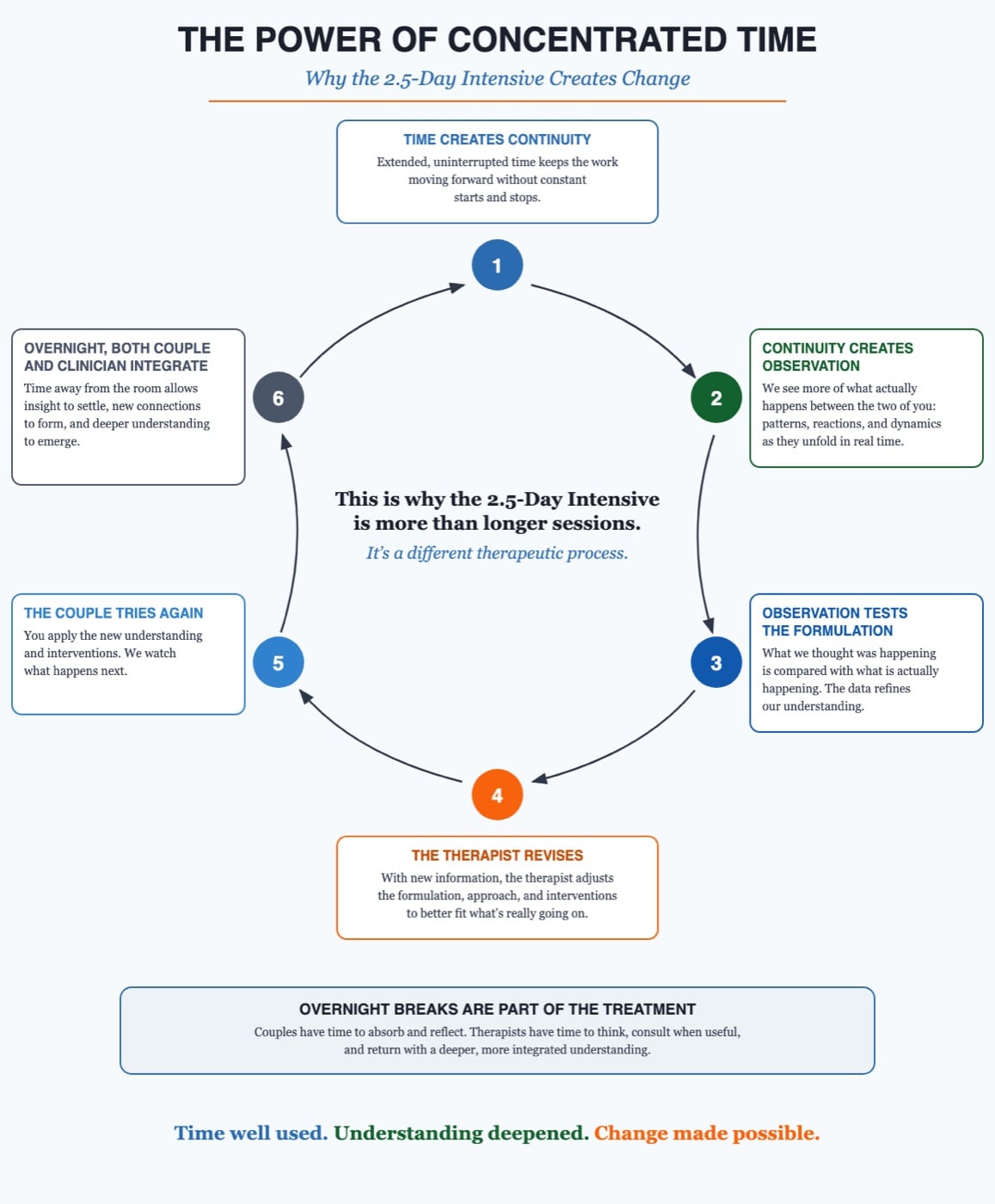
We didn’t arrive at two and a half days because a theory told us that was the correct number. We arrived there after years of watching couples and therapists work. One day often left us with an excellent beginning and too little time to discover where our initial understanding was wrong. Longer concentrated work gave us something we came to value enormously: a chance to understand, intervene, observe, reconsider, and try again.
That experience also taught us something broader about intensive couples therapy.
More time is the most obvious difference. What happens inside that time is what matters.
What Makes Couples Therapy “Intensive”?
Intensive couples therapy is a concentrated form of couples therapy in which one couple works privately with a trained couples therapist for extended sessions, typically over one or more consecutive days. A well-designed intensive includes assessment before treatment, sustained clinical work during the intensive, and a plan for what happens afterward.
“Intensive” refers to the focused structure of the therapy, rather than simply its duration. Longer sessions alone don’t create an effective intensive. The additional time changes what the therapist can learn, what the couple can work through without repeatedly stopping, and what everyone can observe when new understanding is put into practice.
How Long Does an Intensive Last?
There is no standard length across the field. Intensive couples therapy may last one extended day, two days, three days, or longer, depending on the clinician and the approach being used.
At Couples Therapy Inc., we use a 2.5-day format. We arrived at that length through experience rather than a belief that every intensive must be organized the same way.
A True Therapeutic Intensive Is a Three-Legged Stool
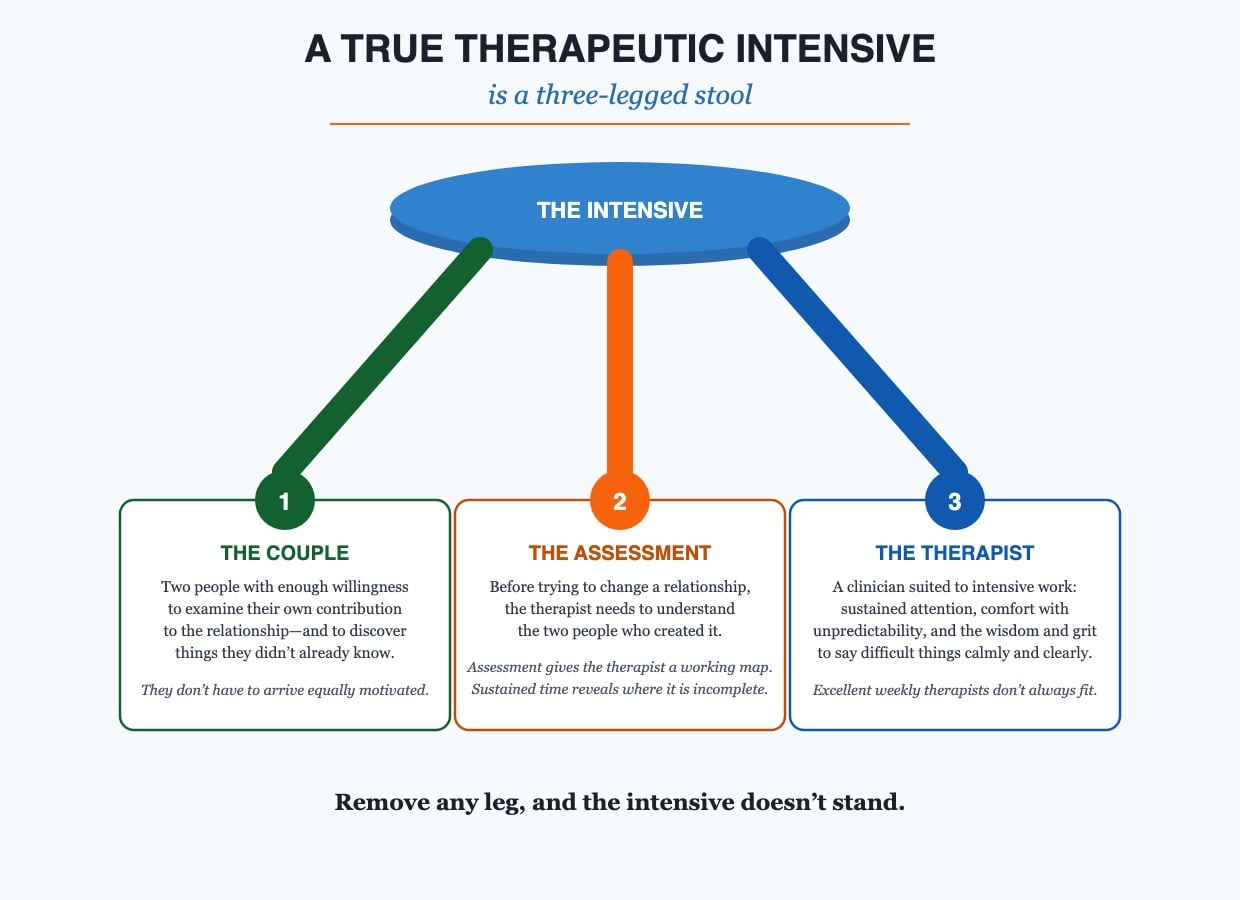
A true therapeutic intensive is a three-legged stool.
The first leg
The first leg is the couple: two people with enough willingness to examine their own contribution to the relationship and consider changing it. They don’t have to arrive equally motivated, equally insightful, or even convinced that they are part of the problem. Most of us are much better at identifying what our partners need to change than recognizing our own part in our misery.
But there has to be some capacity for self-examination and some willingness to discover things you didn’t already know.
The second leg is a thorough assessment.
Before trying to change a relationship, the therapist needs to understand the two people who created it. That includes how each person sees themselves and their partner, what each expects an intimate relationship to provide, the attachment patterns and life experiences they bring with them, and how all of this shows up in the structure and health of their bond.
Assessment gives the therapist a working map.
Spending sustained time with the couple reveals where that map is incomplete.
The third leg is a couples therapist who is suited to intensive work.
Excellent weekly couples therapists don’t necessarily make excellent intensive therapists. The formats ask different things of the clinician. Intensive work requires sustained attention, comfort with unpredictability, the ability to revise a clinical understanding as new information emerges, and the wisdom and grit to say difficult things calmly and clearly.
Telling the Truth, Therapeutically
That last quality matters.
The nature of a problem doesn’t change because a therapist wishes it away or refuses to name it.
Couples often want things that conflict. One person may say, “I want our marriage to improve, and I want to say things in whatever way feels true for me.” Their partner may be saying, just as clearly, “I am no longer willing to be spoken to that way.”
The therapist doesn’t get to decide what either person must accept.
I sometimes tell couples, “It doesn’t matter what I think because I’m not married to you. I can tell you what science says. But if your partner is willing to settle for terrible behavior on your part, science is mute.”
Collaboration Requires Two People
The same is true of desires.
You can want something desperately. You can believe it would be wonderful for your marriage, your children, or your future. You can explain why you want it and make the most persuasive case you can.
You can request it.
That’s the extent of your power.
You cannot make your desire your partner’s desire. Threatening consequences may produce acquiescence. It doesn’t produce collaboration.
The therapist can teach how to collaborate. The therapist cannot supply the desire to collaborate.
We Aren’t in the Personality-Changing Business
Two adults arrive after lifetimes spent developing personalities, values, habits, defenses, and ways of relating to other people.
Significant behavioral and relational change can happen. A therapist cannot manufacture a fundamentally different person over a weekend.
If remaining married requires your partner to become someone they do not want to become, or perhaps have never sustainably been, an intensive cannot perform that miracle.
Sometimes what changes instead is the couple’s understanding of their situation.
Each person becomes clearer about what the other is willing to do, unwilling to do, capable of changing, and determined to keep. With that clarity, people can make more intelligent decisions about how to proceed.
How Is Intensive Couples Therapy Different from Weekly Couples Therapy?
Fifty-minute couples therapy can work very well for relatively healthy, adaptable couples who learn quickly, take an idea home, use it, and come back ready for the next piece.
At the other extreme are people for whom sustained self-examination is so difficult that fifty minutes may be as much as they can productively tolerate.
Most distressed couples I see fall somewhere in the large territory between those extremes.
They can understand something at 10:00 in the morning and demonstrate at 2:00 that they haven’t understood it quite as well as everyone thought.
In an intensive, the therapist gets to see that happen.
A formulation can be tested, revised, and tested again. The couple can move beyond talking about how their relationship works and begin showing the therapist how it works, right there in the room.
A person may sincerely tell us, “I’m perfectly willing to hear what she wants.”
Twenty minutes later, she tells him what she wants.
And there it is.
Weekly therapy often requires the therapist to hear about what happened between sessions. During an intensive, much more of the relationship has an opportunity to happen in front of us. Or over a 15-minute break. Or lunch hour.
That is what concentrated time gives us.
Intensive couples therapy gives us enough continuity to discover what is actually happening and enough time to do something useful with what we discover.
Why We Use a 2.5-Day Format
After 15 years of doing intensive couples therapy work, with now over 4000 couples, 2.5 days has evolved as the most constructive format for the couples we treat.
That wasn’t a number we arrived at by calculating how many weekly therapy hours could be squeezed into a weekend. It grew out of watching what couples and therapists actually need in order to do this work well.
We’ve tried shorter formats, including one-day intensives. A single day can provide useful work, but it has an important limitation: the therapist, using an assessment as a starting formulation, has only limited time to apply it to the couple.
In a 2.5-day intensive, we don’t have to pretend that our first understanding was our best one.
We have time to formulate, intervene, observe what happens, reconsider, and return.
The overnight breaks matter too. Couples have time to absorb the day’s work, and therapists have time to think, consult with senior team members when useful, and come back the following morning with a deeper understanding of what they have seen.
Like many of the therapists on my team, I “sleep on it” for two days over the weekend. This allows my mind to integrate complex issues in a dream state.
That’s why our 2.5-day format isn’t simply a longer appointment. It’s a continually evolving understanding of this couple in this setting over this time period.
What Happens Before and During Intensive Couples Therapy?
There is no universal protocol for intensive couples therapy. The exact process varies according to the clinician, therapeutic approach, length of the intensive, and needs of the couple.
But good intensive work begins before the therapist starts trying to change anything.
Assessment matters because the problem a couple initially describes is rarely the whole relationship. The therapist needs some understanding of each partner as an individual, their history together, important relationship injuries, attachment patterns, expectations, strengths, vulnerabilities, and the different stories each tells about how they arrived here.
Then the assessment meets reality.
During the intensive, the therapist develops and continually tests a clinical understanding of the relationship. The couple talks. They interact. The therapist intervenes. Something changes or doesn’t. New information emerges. An explanation that seemed convincing may need to be revised.
Extended work does not mean sitting in a therapy chair without interruption for eight hours. Good intensive work includes breaks. Couples need time to eat, walk, breathe, talk privately, or simply stop thinking about their marriage for a while. Those pauses can become clinically informative too. Something may happen over a fifteen-minute break or lunch hour that tells us as much about the relationship as what happened immediately before it.
The work can include education, exploration of painful events, practicing different ways of communicating, understanding emotional reactions, changing repetitive patterns, making decisions, or simply slowing something down enough that both people can finally see what has been happening.
Different therapeutic models approach these tasks differently.
The essential point is that an intensive gives the therapist and couple enough continuity to remain with the work as it develops.
Assessment gives us a hypothesis.
The couple gives us the opportunity to find out whether we were right.
Who Is a Good Candidate for Intensive Couples Therapy?
You do not have to be in crisis to benefit from intensive couples therapy. Some couples come because their relationship is in serious trouble; others come because they can see where things are heading and would rather intervene before a crisis develops. Still others are happy couples who would like to feel closer and more connected, or busy couples who see an intensive as a way of spending quality time to intensify their bond.
A couple doesn’t need to have a relatively healthy relationship to benefit from an intensive. People seek intensive couples therapy precisely because something important is happening.
They may be painfully disconnected. They may be fighting constantly. They may be recovering from an affair or another serious betrayal. Their sexual relationship may have deteriorated. They may have spent years circling the same problem. Weekly therapy may have stalled, or their lives may make weekly treatment difficult.
Nor do both people have to arrive with equal insight.
A person can enter an intensive convinced that 90 percent of the problem belongs to the person sitting beside them. Most couples arrive with some version of that arithmetic.
What matters is what happens when the arithmetic begins to change.
An intensive requires enough willingness from both people to participate in that process.
If this sounds like the two of you, our couples therapy intensives are described here.
How Do Couples Prepare for Intensive Couples Therapy?
Preparation varies by clinician, but a good intensive usually begins before the couple arrives. That may include written assessment, individual histories, questionnaires, interviews, or conversations about the couple’s goals and concerns.
Couples should also arrive prepared to work rather than perform. You do not need to agree on what is wrong. In fact, you probably won’t. The important preparation is a willingness to describe the relationship honestly, hear information you may not like, and allow the therapist’s understanding to develop rather than trying to recruit the therapist to one side.
At Couples Therapy Inc., our preparation is extensive because we would rather spend valuable intensive time testing and refining an initial understanding than beginning with a blank sheet of paper. We also offer suggested readings as well as the BIG BIG Book.
When Is Intensive Couples Therapy a Poor Fit?
More therapy is not automatically appropriate simply because a relationship is in more trouble.
There are circumstances in which intensive couples therapy may be unsafe, clinically inappropriate, or simply the wrong intervention. Active safety concerns, some forms of severe instability, untreated substance problems, or circumstances in which one person cannot participate freely may need to be addressed before couples therapy can be useful.
Ambivalence also requires careful assessment. Being uncertain about a marriage does not automatically make someone inappropriate for an intensive. Sometimes uncertainty is exactly what needs attention. But couples therapy cannot work very well when one person has no intention of participating in the work and has come solely to have the therapist change their partner.
Screening couples out is part of doing this work responsibly.
A careful intensive therapist should therefore be willing to say no or shift focus when couples therapy becomes counter-indicated.
Is Intensive Couples Therapy the Same as a Couples Retreat?
The language surrounding intensive couples work is wonderfully untidy.
Couples intensive, marriage intensive, couples therapy retreat, marriage retreat, couples workshop, and relationship retreat are sometimes used to describe services that have very little in common.
A therapeutic couples intensive is psychotherapy conducted by a licensed mental health professional with appropriate training in couples therapy.
A couples workshop is usually educational. Several couples may attend together to learn relationship concepts or skills.
Coaching operates under a different professional and regulatory framework from psychotherapy.
And retreat often describes the setting or experience rather than telling you very much about what will actually happen there. A retreat may involve psychotherapy, coaching, education, wellness activities, or some combination of them.
So don’t choose based on what somebody calls the work.
Find out what’s inside it.
Being a good consumer means knowing what services are being offered and by whom.
What Can Intensive Couples Therapy Realistically Accomplish?
No responsible couples therapist can promise that an intensive will save a marriage.
Sometimes significant change happens. A couple recognizes a destructive pattern they have repeated for years. Someone understands their partner differently. An injury that has remained raw finally becomes possible to discuss. New behavior begins to replace something that has been damaging the relationship.
Sometimes the accomplishment is clarity.
A couple may discover that they have been trying to solve the wrong problem. One partner may finally understand what the other has been asking for. Two people may discover that what each wants from the relationship is fundamentally different.
An intensive can help people understand those realities and decide what they want to do with them.
What it cannot do is guarantee an outcome, manufacture motivation, or transform one adult into the person another adult wishes they would become.
What Happens After an Intensive?
An intensive shouldn’t end without a plan for what comes next. But years of experience taught us something unexpected about aftercare.
For years, we kept follow-up care in-house. We even included two 80-minute follow-up sessions at no additional charge after the intensive.
What surprised us was how many couples simply didn’t use them.
That caused us to reconsider what useful aftercare actually looks like.
We found that it was both less expensive for couples and more practical for therapists to allow couples to continue privately with the clinician who conducted their intensive.
The therapist already knows the couple, their assessment, their history, the patterns that emerged during the intensive, and the work they began together. There is no need to start over.
Our structure makes this possible because all we do as an organization is intensive couples therapy. Unlike practices that incorporate intensives among a variety of services, our clinical work together is focused on this format.
It is what we discuss in Team Meetings: difficult cases from the over 4,000 intensives we’ve conducted, what worked, what didn’t, and how we can continually improve our intensive skills.
Afterward, couples who want additional therapy can continue the work privately with their chosen clinician in that therapist’s own practice.
The intensive is delivered within a clinical organization devoted to intensive couples therapy. Continued care comes from the therapist who already knows the couple, in a setting that is more flexible and typically less expensive. And we get to keep doing the one thing we do.
What our 2.5-day couples therapy intensives include — locations, clinicians, and scheduling — is here.
What Does the Research Tell Us About Intensive Couples Therapy?
Somewhere along the way, our field did some arithmetic. An intensive packs in more clinical hours than most couples get in months of weekly sessions — once you subtract vacations, cancellations, and the week everyone had the flu. Input: hours. Output: hours. Fair enough. We’ve done this math ourselves.
Then marketing got hold of it, and the machine started doing something else entirely. Hours turned to months, months became progress, then “outcomes.” Suddenly some colleagues were saying “equal to a year of therapy in a single weekend.”
Hours went in. Effectiveness came out. Enough nonsense. Three days can still change a relationship.
Couples therapy has been studied extensively.
Intensive couples therapy has not.
There is some encouraging research on couples receiving therapy in concentrated formats. One study of 118 married couples receiving intensive Restoration Therapy found improvements in marital satisfaction that remained at a two-year follow-up. Other researchers have studied intensive couple-based treatment with specialized populations, including military couples coping with PTSD.
These findings are promising, but the research base on intensive couples therapy remains small.
Importantly, these studies don’t establish that several consecutive days of couples therapy produce better outcomes than the same therapy delivered weekly. That is a different research question.
Even the Gottman Institute, whose foundational relationship research has enormously influenced the field, is currently studying its marathon couples therapy format and states that more research on marathon-style therapy is needed.
Much of Gottman’s foundational work answered another valuable question: What patterns distinguish couples whose relationships thrive from couples whose relationships deteriorate?
That observational research helps therapists know what to notice. It doesn’t establish that teaching every couple to adopt those behaviors will produce the same outcome.
So, we use research as one source of clinical information. It helps us know what to assess, what to watch for, and which interventions are reasonable to try.
Then we watch what happens with the two people sitting in front of us.
Research is useful to us. We just don’t ask it to say more than it knows.
How Do You Choose an Intensive Couples Therapist?
Being a licensed therapist doesn’t make someone a couples therapist. And being an excellent couples therapist doesn’t necessarily make someone an excellent intensive couples therapist.
Training matters. Experience working specifically with couples matters. A clinician should be able to explain the therapeutic approach that informs their work, how they assess couples before an intensive, and how they determine whether someone is appropriate for this format.
But intensive work asks for something else too.
You have to enjoy being surprised.
A good intensive therapist needs enough confidence to say, calmly, what nobody in the room particularly wants said, and enough humility to recognize several hours later that they may not have understood something quite right.
They have to hold two individual people in mind while simultaneously watching the third thing those people have created together: their relationship.
And they have to remain interested.
Hour after hour.
Some wonderful weekly couples therapists find that exhausting. Other therapists come alive in it.
Ask a prospective intensive therapist what happens when their first understanding of a couple turns out to be wrong. Ask what they do before the intensive. Ask what kinds of couples they decline to treat. Ask what happens afterward.
And listen to whether they can talk about the limits of what they do.
Certainty is easy to sell.
Good couples therapy requires considerably more curiosity.
We’ve discovered something else: We’ve hired therapists with decades of excellent weekly couples work who discovered, within six months and after only a few particularly challenging intensives, that this format exhausted them. We’ve also watched therapists with less experience in weekly work bloom in the intensive environment, with the couple reviews to prove it.
Frequently Asked Questions About Intensive Couples Therapy
Is intensive couples therapy better than weekly couples therapy?
Neither format is best for every couple. Weekly therapy works extremely well for some people. Intensive therapy offers sustained time and continuity that can be particularly useful when a couple and therapist need to remain with complicated work rather than repeatedly stopping and restarting it.
Can an intensive save our marriage?
No therapist can responsibly guarantee that. An intensive can create conditions for understanding and change. What two people ultimately decide and what each is willing to change remain theirs.
What if one of us isn’t sure we want to stay married?
Ambivalence does not automatically rule out intensive work. A Discernment Counseling weekend has helped many couples decide with clarity and confidence whether they want to work on their marriage, separate or divorce, or keep the status quo. Discernment Counseling isn’t couples therapy but it can help the couple in ambivalence make important decisions. Learn more about Discernment Counseling.
Can intensive couples therapy help after an affair?
Infidelity and other significant betrayals are common reasons couples seek intensive treatment. Whether an intensive is appropriate depends on the circumstances, including whether an affair is ongoing and what each partner is prepared to do. For example, an ongoing affair, even a hidden one, makes couples therapy ineffective. However, no ongoing affair needs to be disclosed in Discernment Counseling. Learn more.
Can intensive couples therapy be done online?
Some clinicians provide intensive couples therapy online, depending on their clinical model and professional licensing requirements. Because regulations and practices vary, couples should ask the clinician directly about whether virtual intensive treatment is available and appropriate for them. Couples Therapy Inc., for example, can provide online intensive couples therapy in some cases.
How much does intensive couples therapy cost?
Fees vary considerably (our costs are here) according to the length of the intensive, clinician, location, and services included. Couples should look beyond the total price and determine how much clinical time, assessment, preparation, and follow-up are actually included.
Does insurance cover intensive couples therapy?
With rare exception, insurance benefits in the USA do not cover even weekly couples therapy. Those that do, often have limitations on how many hours per day are allowed. Intensive couples therapy programs are private-pay services. Those offering insurance coverage usually do so by labeling one partner as having a psychiatric condition that is the focus of treatment. Learn more.
When you’re ready: our couples therapy intensives — what they include, where we offer them, and with whom.
References
- Ahlquist, L. R., & Hargrave, T. D. (2022). Effectiveness of Restoration Therapy in an Intensive Model. The Family Journal, 30(3). doi.org/10.1177/10664807211052481
- Fredman, S. J., Le, Y., Macdonald, A., Monson, C. M., et al. (2021). A Closer Examination of Relational Outcomes from a Pilot Study of Abbreviated, Intensive, Multi-Couple Group Cognitive-Behavioral Conjoint Therapy for PTSD with Military Dyads. Family Process, 60(3). doi.org/10.1111/famp.12654
- The Gottman Institute. Gottman Method Marathon Couples Therapy Study. gottman.com